
THE VIZSLA


Brief history
The "Huns Magyars" (Hungarian ancestors) have honed their dogs along the Danube River valleys for a long time since their origins. These aroused the fascination of the Ottoman aristocracy during the occupation of the territory, which soon tried to improve them with their own squads. The patterns we know of the Rövidszörü Magyar Vizsla dog breed have remained almost intact throughout its evolution. It is believed that this Hungarian Pointer, unique in purity among European hunters, originated from crosses of this ancestral Magyar dog with an Arabian Hare, believed to be the extinct Turkish Yellow Dog and also with the extinct Pannonian Hound.
The Vizsla was only described for the first time in the 14th century and in the Ottoman occupation of Hungary, but it is known through images painted over a thousand years ago, tapestry scenes, paintings and engravings, that the breed was present much longer with the Hungarian people, from their beginnings, based on hunting for survival among the eastern plains, and believe me, they are the same images that we see today, and they reproduce the same qualities and functions.
With the successive occupations and wars, oppressions of Hungarian culture and changes throughout the nation's history, still added to its aristocratic origins in Hungary, the extinction of the Magyar Vizsla was feared at many times, especially during and after World War II, when the Soviet communist occupation controlled the region and exercised a policy of expropriating the remaining aristocracies. According to tradition, the breed was recovered with approximately 15 specimens and by expatriates who took their dogs to countries such as Argentina, the USA and Canada. In Brazil, Vizsla is still present in a discreet way.
Behavior
Vizsla dogs are loving in nature, intelligent, faithful, affectionate and balanced, fast and with a sensitive sense of smell. They are docile, obedient and easy to train dogs. The Viszla's temperament, like the vast majority of pointing dogs, is marked by docility and ease of learning.
Extremely gentle with children, when resting and calm, Vizslas reach euphoric status very quickly if encouraged to play. You can play ball and throw it more than 100 times, your friend will always have more energy to spend. They get along well with children as long as they treat them with respect. They are energetic and love to run and play with their owners.
With a respectful bearing and gentle grandeur, the handsome Braco ends up intimidating many people who do not know the breed, and often due to such a reaction the Vizsla has once again its ancestral instincts activated, it may want to 'investigate' by itself the person who uncomfortable with him. Aggression, fear and repulsion towards water must be rejected and not encouraged.
Aspect
It is a medium-bodied, short-backed dog with a muscular build. With endurance and muscular explosion and a lot, we emphasize, a lot of speed. He has a muscular head and a
square muzzle that gradually narrows. Prominent open chest is expected, small white spot on chest is accepted by breed standards. It is possible to find Vizslas of colors Wheat and or, Gold or Red-Gold uniforms. Less common are the very light ones and these should be deprived of exposure and breeding. Belly slightly concave. Its ears are thin, silky, wide, and its eyes are oval and brown, despite variations in blue, green, and yellow.
Height: Males - (56 - 66 cm); Females - (51 - 61 cm).
Weight: Males - (20 - 29 kg); Females - (18 - 25 kg).
Training
Your new friend Vizsla requires a lot of physical contact and is sensitive to brutality. Educating him is essential to being able to control him. The Hungarian Pointer is considered by many dog breeders as the most refined of Pointers and Pointers, the most complete friend for pointing, company and games. Your new friend is very fond of balls and other throwing objects and all the games you propose. Without hesitating, the dog will show all its muscular strength and burst of energy, and it is not advisable to block them and deprive them of playing and interacting.
Highly trainable, it requires effort to interact with the owner and the family, to always be training and acting in the same way with the dog among the members, so that Vizsla is not confused with different commands and training. The training must be faithfully followed by all individuals involved. Being a very attached dog to its owner, it is not suitable for those owners who need to be away for long periods of time. Very obedient and attached, it demands a lot of love and will get a better performance in training if it is led by the owner and his family.
Its work dynamics, in the countryside and in the city, can be easily directed to any activity desired by the owner, as long as the repetition of commands is perfectly synchronized with those involved, family and friends. They accompany their owners in various activities proposed by the owner such as swimming, hunting with pointers or with prey, beat hunting, agility and obedience tests, rally, flyball, search and rescue, truffle sniffing, hiking, guide and companion dogs, Vizsla being the most versatile and elegant dog. It earned him good nicknames during its propagation around the world, such as “the rich man's hunting dog” and “velcro dog”.
Spectacular in hunting, described throughout the literature on the breed, it plays a safe point and is also an excellent retriever, quick to find its prey, it is capable of hunting perfectly. The Vizsla occupies a very select group of HPR Dogs, "Hunting" to hunt, "Pointing" to aim and "Retrieving" to seek. The Vizsla is the versatile dog that perfectly combines the qualities of the Setter, Pointer and Retriever, in the field, woods or water. Their ancestors are directly linked to Eastern European Falconry, and every day we must remember their origin and how special they are.
Specific care
Although the Vizsla is an athletic looking dog, it is recommended to keep him indoors with his family, as he is a very sensitive dog and does not like to be separated from his family members. It is also recommended to provide a garden and regular exercise. When bored, it can get a little destructive, but a good run would solve any bad mood. If provoked and treated harshly, it can become a cornered and fearful dog and thus not exacerbate its inborn and ancestral qualities.
It is always good to keep a specific place that belongs to the puppy, well padded, dry and warm, so that the relationship of trust with those who handle it is as loving as possible. You will always find him by the fireplace, or in the sun, lying on something warm even on top of his owners. Very alert and connected with what is going on around them, Vizslas usually greet and warn the arrival of people, but they will never be violent. Very active, it is difficult to see them trapped by chains and collars, they need a large radius of space in relation to the owner, to run, sniff, and trace their space, but very faithful, they always come back when called and if well educated.
Coat: Does not need much care and does not shed hair to the point of being a problem in any home. Its coat is waterproof which makes it even more of a natural swimmer and water lover. Its short coat is dense and soft, with only one layer that protects it from the cold (undercoat), but it is not a dog that should sleep outdoors or without shelter, on the contrary, it loves a good blanket.
health and hygiene
The Vizsla is not prone to specific illnesses, the problems that affect it are common to many breeds. Vizslas are more prone to allergies and some intolerance that refer to their sensitivity and sensitive skin.
Your new friend is very hygienic, all specimens are. They clean themselves constantly and they can take regular baths as long as they use neutral soaps. Skills that resemble felines have already been described in their literature, in the use of their paws and hygiene habits.

Brief history
The "Huns Magyars" (Hungarian ancestors) have honed their dogs along the Danube River valleys for a long time since their origins. These aroused the fascination of the Ottoman aristocracy during the occupation of the territory, which soon tried to improve them with their own squads. The patterns we know of the Rövidszörü Magyar Vizsla dog breed have remained almost intact throughout its evolution. It is believed that this Hungarian Pointer, unique in purity among European hunters, originated from crosses of this ancestral Magyar dog with an Arabian Hare, believed to be the extinct Turkish Yellow Dog and also with the extinct Pannonian Hound.
The Vizsla was only described for the first time in the 14th century and in the Ottoman occupation of Hungary, but it is known through images painted over a thousand years ago, tapestry scenes, paintings and engravings, that the breed was present much longer with the Hungarian people, from their beginnings, based on hunting for survival among the eastern plains, and believe me, they are the same images that we see today, and they reproduce the same qualities and functions.
With the successive occupations and wars, oppressions of Hungarian culture and changes throughout the nation's history, still added to its aristocratic origins in Hungary, the extinction of the Magyar Vizsla was feared at many times, especially during and after World War II, when the Soviet communist occupation controlled the region and exercised a policy of expropriating the remaining aristocracies. According to tradition, the breed was recovered with approximately 15 specimens and by expatriates who took their dogs to countries such as Argentina, the USA and Canada. In Brazil, Vizsla is still present in a discreet way.
Behavior
Vizsla dogs are loving in nature, intelligent, faithful, affectionate and balanced, fast and with a sensitive sense of smell. They are docile, obedient and easy to train dogs. The Viszla's temperament, like the vast majority of pointing dogs, is marked by docility and ease of learning.
Extremely gentle with children, when resting and calm, Vizslas reach euphoric status very quickly if encouraged to play. You can play ball and throw it more than 100 times, your friend will always have more energy to spend. They get along well with children as long as they treat them with respect. They are energetic and love to run and play with their owners.
With a respectful bearing and gentle grandeur, the handsome Braco ends up intimidating many people who do not know the breed, and often due to such a reaction the Vizsla has once again its ancestral instincts activated, it may want to 'investigate' by itself the person who uncomfortable with him. Aggression, fear and repulsion towards water must be rejected and not encouraged.
Aspect
It is a medium-bodied, short-backed dog with a muscular build. With endurance and muscular explosion and a lot, we emphasize, a lot of speed. He has a muscular head and a
square muzzle that gradually narrows. Prominent open chest is expected, small white spot on chest is accepted by breed standards. It is possible to find Vizslas of colors Wheat and or, Gold or Red-Gold uniforms. Less common are the very light ones and these should be deprived of exposure and breeding. Belly slightly concave. Its ears are thin, silky, wide, and its eyes are oval and brown, despite variations in blue, green, and yellow.
Height: Males - (56 - 66 cm); Females - (51 - 61 cm).
Weight: Males - (20 - 29 kg); Females - (18 - 25 kg).
Training
Your new friend Vizsla requires a lot of physical contact and is sensitive to brutality. Educating him is essential to being able to control him. The Hungarian Pointer is considered by many dog breeders as the most refined of Pointers and Pointers, the most complete friend for pointing, company and games. Your new friend is very fond of balls and other throwing objects and all the games you propose. Without hesitating, the dog will show all its muscular strength and burst of energy, and it is not advisable to block them and deprive them of playing and interacting.
Highly trainable, it requires effort to interact with the owner and the family, to always be training and acting in the same way with the dog among the members, so that Vizsla is not confused with different commands and training. The training must be faithfully followed by all individuals involved. Being a very attached dog to its owner, it is not suitable for those owners who need to be away for long periods of time. Very obedient and attached, it demands a lot of love and will get a better performance in training if it is led by the owner and his family.
Its work dynamics, in the countryside and in the city, can be easily directed to any activity desired by the owner, as long as the repetition of commands is perfectly synchronized with those involved, family and friends. They accompany their owners in various activities proposed by the owner such as swimming, hunting with pointers or with prey, beat hunting, agility and obedience tests, rally, flyball, search and rescue, truffle sniffing, hiking, guide and companion dogs, Vizsla being the most versatile and elegant dog. It earned him good nicknames during its propagation around the world, such as “the rich man's hunting dog” and “velcro dog”.
Spectacular in hunting, described throughout the literature on the breed, it plays a safe point and is also an excellent retriever, quick to find its prey, it is capable of hunting perfectly. The Vizsla occupies a very select group of HPR Dogs, "Hunting" to hunt, "Pointing" to aim and "Retrieving" to seek. The Vizsla is the versatile dog that perfectly combines the qualities of the Setter, Pointer and Retriever, in the field, woods or water. Their ancestors are directly linked to Eastern European Falconry, and every day we must remember their origin and how special they are.
Specific care
Although the Vizsla is an athletic looking dog, it is recommended to keep him indoors with his family, as he is a very sensitive dog and does not like to be separated from his family members. It is also recommended to provide a garden and regular exercise. When bored, it can get a little destructive, but a good run would solve any bad mood. If provoked and treated harshly, it can become a cornered and fearful dog and thus not exacerbate its inborn and ancestral qualities.
It is always good to keep a specific place that belongs to the puppy, well padded, dry and warm, so that the relationship of trust with those who handle it is as loving as possible. You will always find him by the fireplace, or in the sun, lying on something warm even on top of his owners. Very alert and connected with what is going on around them, Vizslas usually greet and warn the arrival of people, but they will never be violent. Very active, it is difficult to see them trapped by chains and collars, they need a large radius of space in relation to the owner, to run, sniff, and trace their space, but very faithful, they always come back when called and if well educated.
Coat: Does not need much care and does not shed hair to the point of being a problem in any home. Its coat is waterproof which makes it even more of a natural swimmer and water lover. Its short coat is dense and soft, with only one layer that protects it from the cold (undercoat), but it is not a dog that should sleep outdoors or without shelter, on the contrary, it loves a good blanket.
health and hygiene
The Vizsla is not prone to specific illnesses, the problems that affect it are common to many breeds. Vizslas are more prone to allergies and some intolerance that refer to their sensitivity and sensitive skin.
Your new friend is very hygienic, all specimens are. They clean themselves constantly and they can take regular baths as long as they use neutral soaps. Skills that resemble felines have already been described in their literature, in the use of their paws and hygiene habits.
Brief history
The "Huns Magyars" (Hungarian ancestors) have honed their dogs along the Danube River valleys for a long time since their origins. These aroused the fascination of the Ottoman aristocracy during the occupation of the territory, which soon tried to improve them with their own squads. The patterns we know of the Rövidszörü Magyar Vizsla dog breed have remained almost intact throughout its evolution. It is believed that this Hungarian Pointer, unique in purity among European hunters, originated from crosses of this ancestral Magyar dog with an Arabian Hare, believed to be the extinct Turkish Yellow Dog and also with the extinct Pannonian Hound.
The Vizsla was only described for the first time in the 14th century and in the Ottoman occupation of Hungary, but it is known through images painted over a thousand years ago, tapestry scenes, paintings and engravings, that the breed was present much longer with the Hungarian people, from their beginnings, based on hunting for survival among the eastern plains, and believe me, they are the same images that we see today, and they reproduce the same qualities and functions.
With the successive occupations and wars, oppressions of Hungarian culture and changes throughout the nation's history, still added to its aristocratic origins in Hungary, the extinction of the Magyar Vizsla was feared at many times, especially during and after World War II, when the Soviet communist occupation controlled the region and exercised a policy of expropriating the remaining aristocracies. According to tradition, the breed was recovered with approximately 15 specimens and by expatriates who took their dogs to countries such as Argentina, the USA and Canada. In Brazil, Vizsla is still present in a discreet way.
Behavior
Vizsla dogs are loving in nature, intelligent, faithful, affectionate and balanced, fast and with a sensitive sense of smell. They are docile, obedient and easy to train dogs. The Viszla's temperament, like the vast majority of pointing dogs, is marked by docility and ease of learning.
Extremely gentle with children, when resting and calm, Vizslas reach euphoric status very quickly if encouraged to play. You can play ball and throw it more than 100 times, your friend will always have more energy to spend. They get along well with children as long as they treat them with respect. They are energetic and love to run and play with their owners.
With a respectful bearing and gentle grandeur, the handsome Braco ends up intimidating many people who do not know the breed, and often due to such a reaction the Vizsla has once again its ancestral instincts activated, it may want to 'investigate' by itself the person who uncomfortable with him. Aggression, fear and repulsion towards water must be rejected and not encouraged.
Aspect
It is a medium-bodied, short-backed dog with a muscular build. With endurance and muscular explosion and a lot, we emphasize, a lot of speed. He has a muscular head and a
square muzzle that gradually narrows. Prominent open chest is expected, small white spot on chest is accepted by breed standards. It is possible to find Vizslas of colors Wheat and or, Gold or Red-Gold uniforms. Less common are the very light ones and these should be deprived of exposure and breeding. Belly slightly concave. Its ears are thin, silky, wide, and its eyes are oval and brown, despite variations in blue, green, and yellow.
Height: Males - (56 - 66 cm); Females - (51 - 61 cm).
Weight: Males - (20 - 29 kg); Females - (18 - 25 kg).
Training
Your new friend Vizsla requires a lot of physical contact and is sensitive to brutality. Educating him is essential to being able to control him. The Hungarian Pointer is considered by many dog breeders as the most refined of Pointers and Pointers, the most complete friend for pointing, company and games. Your new friend is very fond of balls and other throwing objects and all the games you propose. Without hesitating, the dog will show all its muscular strength and burst of energy, and it is not advisable to block them and deprive them of playing and interacting.
Highly trainable, it requires effort to interact with the owner and the family, to always be training and acting in the same way with the dog among the members, so that Vizsla is not confused with different commands and training. The training must be faithfully followed by all individuals involved. Being a very attached dog to its owner, it is not suitable for those owners who need to be away for long periods of time. Very obedient and attached, it demands a lot of love and will get a better performance in training if it is led by the owner and his family.
Its work dynamics, in the countryside and in the city, can be easily directed to any activity desired by the owner, as long as the repetition of commands is perfectly synchronized with those involved, family and friends. They accompany their owners in various activities proposed by the owner such as swimming, hunting with pointers or with prey, beat hunting, agility and obedience tests, rally, flyball, search and rescue, truffle sniffing, hiking, guide and companion dogs, Vizsla being the most versatile and elegant dog. It earned him good nicknames during its propagation around the world, such as “the rich man's hunting dog” and “velcro dog”.
Spectacular in hunting, described throughout the literature on the breed, it plays a safe point and is also an excellent retriever, quick to find its prey, it is capable of hunting perfectly. The Vizsla occupies a very select group of HPR Dogs, "Hunting" to hunt, "Pointing" to aim and "Retrieving" to seek. The Vizsla is the versatile dog that perfectly combines the qualities of the Setter, Pointer and Retriever, in the field, woods or water. Their ancestors are directly linked to Eastern European Falconry, and every day we must remember their origin and how special they are.
Specific care
Although the Vizsla is an athletic looking dog, it is recommended to keep him indoors with his family, as he is a very sensitive dog and does not like to be separated from his family members. It is also recommended to provide a garden and regular exercise. When bored, it can get a little destructive, but a good run would solve any bad mood. If provoked and treated harshly, it can become a cornered and fearful dog and thus not exacerbate its inborn and ancestral qualities.
It is always good to keep a specific place that belongs to the puppy, well padded, dry and warm, so that the relationship of trust with those who handle it is as loving as possible. You will always find him by the fireplace, or in the sun, lying on something warm even on top of his owners. Very alert and connected with what is going on around them, Vizslas usually greet and warn the arrival of people, but they will never be violent. Very active, it is difficult to see them trapped by chains and collars, they need a large radius of space in relation to the owner, to run, sniff, and trace their space, but very faithful, they always come back when called and if well educated.
Coat: Does not need much care and does not shed hair to the point of being a problem in any home. Its coat is waterproof which makes it even more of a natural swimmer and water lover. Its short coat is dense and soft, with only one layer that protects it from the cold (undercoat), but it is not a dog that should sleep outdoors or without shelter, on the contrary, it loves a good blanket.
health and hygiene
The Vizsla is not prone to specific illnesses, the problems that affect it are common to many breeds. Vizslas are more prone to allergies and some intolerance that refer to their sensitivity and sensitive skin.
Your new friend is very hygienic, all specimens are. They clean themselves constantly and they can take regular baths as long as they use neutral soaps. Skills that resemble felines have already been described in their literature, in the use of their paws and hygiene habits.


-
Allergies
-
Arthritis
-
Atopic Dermatitis
-
Cataracts
-
Corneal Dystrophy
-
Cryptorchidism
-
Distichiasis
-
Entropion
-
Epilepsy
-
Gastric Tortion
-
Glaucoma (Primary)
-
Heart Murmur
-
Hemangiosarcoma
-
Hypothyroidism
-
IMHA (Immune Mediated Hemolytic Anemia)
-
Lymphoma
-
Mast Cell Tumors
-
Polymyositis
-
Progressive Retinal Atrophy
-
Sebaceous Adenitis
-
Umbilical Hernia
-
Von Willbrand’s Disease
Curiosidades sobre o Vizsla
-
Espetacular na caça, descrito por toda a literatura sobre a raça, desempenha um aponte seguro e é também um excelente recuperador, rápido em encontrar a presa, é capaz de caçar de modo perfeito. O Vizsla ocupa um seletíssimo grupo de Cães HPR, "Hunting" caçar, "Pointing" apontar e "Retrieving" buscar.
-
O Braco Húngaro de pelo curto é o cão mais versátil; combina com perfeição as qualidades do Setter, do Pointer e do Retriever no campo, bosques ou na água. Seu desenvolvimento como raça está diretamente ligado à cultura de Falcoaria do leste europeu devemos lembrar sua origem para entender quão especial são, os Rövidszörü Magyar Vizslas.
-
Magyar Vizslas de pelo curto são talvez os mais únicos entre os Apontadores. Entre todas as diferenças, na maioria dos Vizslas há a presença quase certa de pequenos apêndices nas orelhas, conhecidos como 'horns', "Gretchenhof horns", "Grebenbruch horns" ou "Futaki Horns"; são inofensivos e não apresentam mal algum.
-
O Vizsla é conhecido por ser o "Velcro Dog", o Cão-velcro por estar sempre grudado ao dono e à sua Família. É considerado um cão de Alta Adestrabilidade e um cão de Aponte de pássaros. Precisam estar junto à Família e têm Ansiedade de Separação significativa.
-
O Vizsla de pelo curto quase entrou Extinção. Estima-se que a Raça foi retomada por apenas 15 Exemplares após 1940. Esses cães refugiados da Guerra são considerados os Patriarcas e Matriarcas da atual Raça Magyar Vizsla.
-
A partir de 1970 começam discussões sobre coloração, métodos de escolha de reprodutores e quais qualidades, se de Caça ou de Exposição, deveriam influenciar a Raça. Os gostos particulares e tendências fenotípicas da raça Magyar Vizsla surgem como método adicional à escolha dos exemplares reprodutores e, não somente a qualidade e tendência para a caça são levadas em consideração pelos propagadores da época até hoje. Podemos notar a discussão do tema já nos E.U.A., de acordo com Artigo nomeado "What now, Brown dog?" publicado na 1a Edição da "Hungarian Review", em 1971. O Vizsla é historicamente e essencialmente um cão de trabalho, amarelado e afinado nos extremos, porém ao longo dos anos essas características vêm se perdendo e suprimidas pelas angulações e qualidades das Exposições de Cinofilia. Qualidades em Campo não são possíveis verificar se a prática de caça de aponte é vedada em certa localidade. Veja o artigo: "Hungarian Review - 1a Edição - 1971".
-
O Magyar Vizsla é um cão versátil nas suas utilizações. Pode realizar inúmeras funções e trabalhos que vão desde Cão de Companhia e de Serviço, até Cão de Resgate e para trabalhos específicos de maior complexidade. Fale conosco sobre os tipos de treinamento e adequação de um Cão conforme a sua necessidade. Fale conosco sobre a sua necessidade em particular.
-
Apesar de o Vizsla ser uma Raça que tradicionalmente apresenta a Cauda cortada, por muitos motivos entre eles motivos de saúde e bem estar assim como para a otimização do trabalho de aponte, no Brasil e Europa a Caudectomia está vetada para fins de estética e não realizamos este procedimento em nossos cães.
Saiba mais sobre o Canil Magyar Vidám aqui!


Mais Informações sobre o Rövidszörü Magyar Vizsla:
Magyar Vizsla - American Kennel Club Standard
Magyar Vizsla - The Kennel Club Standard
"A Decade of Vizslas 1960-1970" - The Vizsla Club of America delegate to American Kennel Club 1974.
Bibliografia revisada e aprofundada sobre o Rövidszörü Magyar Vizsla:
ROSS D. CLARK, DVM. Medical, Genetic & Behavioral Risk Factors of Vizslas. America's Showdog Veterinarian. Xlibris, USA. 2014.
BROWN, Lolly. Vizsla Dogs. Complete Pet Owner's Manual. NRB Publishing. USA/Nevada. 2022.
SCHWARTZ, Tarah. The Complete Guide to the Vizsla. LP Media Inc. USA/NW. 2021.
DAVIS, Margaret. Vizsla the Complete Owners Guide, revised and expanded. KARM Publishing. Poland, 2017.
BERNER, Michel. Raised by Vizslas. A Collection of random Thoughts, Opinions, and Ramblings on How to Live with Vizslas. USA/ IL, Monee. 2021
HAFEZ, B.; HAFEZ, E. S. E. Reprodução Animal . Ed. Manole. São Paulo/ Brasil. 1a edição - 1962. 6a edição - 1995.
 MAGYAR VIDÁMLINHAGEM EXCLUSIVA |  | 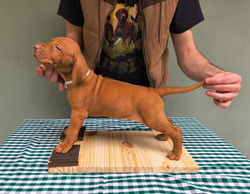 Magyar Vidám Kennel |
|---|